Every year on the Jerry Lewis telethon, America sees a parade
of sick children whom only the coldest hearts could resist. But on this
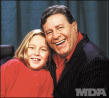
year's program, one of the most poignant figures was Lewis himself. Steroid
drugs that the 77-year-old Lewis must take for a lung condition have shockingly
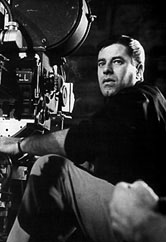
increased his weight by 50 pounds or more. The slender, limber, crazy kid
who became a comic icon in the 1950s has become a strangely inflated version
of himself.
The added weight clearly places burdens on Lewis's abilities
to move and even to breathe, but he held forth nevertheless on Labor Day,
clearly seeing it as his sacred duty. Though he took several hours off in
the middle of the 21-hour telethon, he hosted the opening and closing hours
of the program himself, and with only slightly subdued manic energy. In
the process, he raised a little more than $60 million for the Muscular
Dystrophy Association and its fight against neuromuscular diseases.
I wasn't able to watch all of the telethon and never am, but
I saw several hours of Lewis and never heard any self-pity or complaints
about his own condition. All his attention was directed toward the mission
at hand. Sidekick Ed McMahon, who by this time looks as if he is held together
with cellophane tape and staples, used the corny old line "There's
more of you to love" to Lewis near the start of the show Sunday night,
and Don Rickles, as only he could, at one point referred to Lewis as a "Jew
whale" and said the added weight was "a good gimmick," and
Lewis laughed broadly. "Humanitarian" is one of many recklessly
abused words in show business. When the TV academy launched a new "humanitarian"
award last year, it named it in honor of Bob Hope, most of whose trips entertaining
the military were turned into profitable TV specials, and gave it to Oprah
Winfrey, who apparently has been very generous to various charities. Does
she qualify as a "humanitarian"? If she does, then Jerry Lewis
certainly does. If anybody in show business does, Jerry Lewis does.
Lewis still gets little respect from the American snobocracy,
the cultural elite. He has not been given such overdue awards as a Kennedy
Center Honor; he doesn't fit the profile of the typical honoree. Lewis gets
little respect, but he brings in $60 million for medical research.
He could never be accused of having a shrunken ego, of course,
or exquisitely good manners, either; on occasion during the telethon he
would reprimand the orchestra conductor or a member of his staff, which
seems awfully bad form. But heck, he's a clown, one of the greatest American-born
clowns ever, and clowns are given to the broad, buffoonish gesture. The
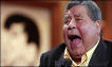
added weight, the medication and the illness make Lewis twitch sometimes,
and grimace, and blink. But he battled his way through to the end -- "heroically"
hardly seems too strong a word -- and when he sang his traditional finale,
"You'll Never Walk Alone," it was literally breathtaking for him
and figuratively breathtaking for those of us watching in amazed admiration.
One had to be thinking, inevitably, that from now on, each telethon
could be his last. The show itself was another triumphantly campy pageant
-- comics, magicians, cheerleaders, tap dancers, impressionists, Vegas-style
singers in shiny tuxedos, even "the Dancing Dads of Peoria, Ariz."
One could feel truly teleported in time, as if show business had been
stopped and frozen in 1962. Out from the wings they came -- all the performers,
minor and major, who wait in the wings for what we used to consider "entertainment"
to make a comeback. And once a year, on Labor Day, it does.
There is also, inevitably, the "they're still alive"
factor. Patti Page? Still alive! She sang "Child of Mine" on the
telethon. Julius La Rosa is still alive; he sang "I've Got a Crush
on You." Also Steve Lawrence and Nancy Sinatra. Tony Orlando is still
alive and seemed to be singing "Purple Rain"; could it have been
the title song of the artist formerly known as Prince's movie? It was unrecognizable
but vigorously rendered.
Not particularly well but very, very contagiously, veteran character
actor Fyvush Finkel sang and danced "To Life!" from "Fiddler
on the Roof." Finkel is more than still alive. Somewhere through the
early-morning blur, I think I saw a violinist rapidly playing "Yankee
Doodle Dandy" on her fiddle. She may have been on roller skates; it's
hard to recall.
"Show people are incredible people," Jerry Lewis said.
"I'm very proud to be one of them." There was in the air a bit
of "Broadway Danny Rose," the movie in which Woody Allen played
the hard-luck manager of a collection of oddball acts. Vaudeville rises
from the grave, sparkling and glistening and shimmering in the light.
The most memorable guest, however, is not in show business.
Near the open and the close of the telecast, Lewis spoke by satellite with
the phenomenal Mattie Stepanek, the 13-year-old poet who is MDA's National
Goodwill Ambassador and appears indeed to be goodwill personified. Ebullient
and articulate, he expressed what had to be a genuine affection for Lewis
and what he has accomplished.
Mattie has accomplished quite a bit, too. Though he suffers
from mitochondrial myopathy, a genetic muscle-weakening disease that affects
his heart rate and breathing (and has already taken the lives of two brothers
and a sister), the young man from Upper Marlboro has written five books
of best-selling poetry, each with the word "heartsongs" in the
title. His dauntless smile on the telethon was inescapably inspiring. You
could not be unmoved.
It doesn't matter that some, even many, of the showbiz acts
on the telethon are mediocre, and it certainly doesn't matter that some
seem to be from another time (in many cases, a better time). What really
matters is how hard they're trying to be good for Jerry and his "kids."
This year's Jerry Lewis telethon, the 38th, was one of the greatest shows
on Earth, and one of America's greatest showmen was the guy who breathed
life into it, even when it appeared he had very little breath to spare.
|